Tatiana is inviting everyone to her upcoming webinar. She would like you to fill this survey to join:
Despite being the overlooked Cinderella of our senses, the impact of smell on our well-being is profound.
Tuesday, February 15, 2022
Introducing Tatiana Guendulain
Wednesday, January 12, 2022
Post-infectious body odor
Every infection has a distinct odor. It could be associated with changes in the gut microbiome. Besides, circulating B-cells from our immune system are also producing chemical odors that appear after viral infection. T-cell and cytokine involvement is also possible. Infections can change body odor for the worse. PATM or MEBO conditions could begin after an infection and linger thereafter.
COVID-19 is known to be associated with a specific odor. Early studies identified volatile compounds that discriminated COVID-19 from other conditions. Some of these compounds - such as fruity smelling ketones - are also associated with diabetes - a risk factor for Severe COVID-19 infection. Another compound, Heptanal, associated with lung cancer, can also predict the severity of the Coronavirus disease.
Dogs (and rats and other animals) can easily detect the smell of COVID-19. They are already helping during this pandemic - Massachusetts schools, for example, are using dogs to sniff out Covid-19. The dogs come to the schools weekly and work to detect cases in empty classrooms, auditoriums, cafeterias and gymnasiums, If Covid is detected, the authorities tell the health nurse who relays the information to the people affected.
Long COVID - when people continue to have symptoms of COVID-19 for months after their initial illness. - has a distinct smell as well. A paper posted today on MedRxiv tells that dogs can easily detect long COVID as well - in at least half of the cases.
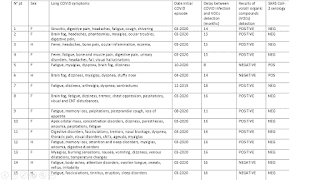
Between May and October 2021, 45 Long COVID patients sent their axillary sweat samples to the National Veterinary School of Alfort. Average age of the patients was 45 (6-71) and 73.3% were female. No patient had been admitted in intensive care unit during the acute phase. Prolonged symptoms had been evolving for an average of 15.2 months (range: 5-22). Main symptoms of prolonged phase were intense fatigue (n=37, 82.2%), neurocognitive disorders such as concentration and attention difficulties, immediate memory loss (n=24, 53.3%), myalgias/arthralgias (n=22, 48.9%), cardiopulmonary symptoms (dyspnea, cough, chest pain, palpitations) (n=21, 46.7%), digestive symptoms (diarrhea, abdominal pain, reflux, gastroparesis...) (n=18, 40.0%), ENT disorders (hyposmia, parosmia, tinnitus, nasal obstruction, inflammatory tongue, dysphonia, sinusitis) (n=18, 40.0%) (table 1). 11 (24.4) patients had at least one positive SARS-CoV-2 serology before any vaccination, 29 (64.4%) had a negative SARS-CoV-2 serology and 5 (11.1%) had no serology results. Snapshot of the table shows some of the cases. Interestingly, patients with odor exhibited symptoms similar to long COVID sufferers in the MEBO community. This includes loss of smell and heart palpitations.
REFERENCES
Tuesday, January 4, 2022
Worried about body odor?
You are not alone. According to pre-COVID surveys, over one third said the fear of smelling unpleasant left them feeling unhappy and unattractive. Many people who survived COVID-19 worry about their body odor getting worse post-infection.
A team of researchers from Virginia Commonwealth University surveyed 322 individuals with loss of smell or taste as a result of confirmed COVID-19 infection and found that about half of them felt depressed and worried about their body odor [Coelho et al., 2021]. Extrapolating results of other surveys, this translates into about 20% of those who got through COVID-19.
The most frequently reported phantom smell (likely not actually there) is the odor of smoke or burned food [Frasnelli et al, 2004]. Interestingly, these are also the most frequently reported types of smells that long-COVID sufferers can't perceive, when others detect them.
Temporary loss of smell is common. About 20% of population experience it sometime before the age of 75. This number increases to ~80% in older age.REFERENCES
Coelho DH, Reiter ER, Budd SG, Shin Y, Kons ZA, Costanzo RM. Quality of life and safety impact of COVID-19 associated smell and taste disturbances. American Journal of Otolaryngology. 2021 Jul 1;42(4):103001.
Frasnelli J, Landis BN, Heilmann S, Hauswald B, Hüttenbrink KB, Lacroix JS, Leopold DA, Hummel T. Clinical presentation of qualitative olfactory dysfunction. European Archives of Oto-Rhino-Laryngology and Head & Neck. 2004 Aug;261(7):411-5.
Maiorano E, Calastri A, Robotti C, Cassaniti I, Baldanti F, Zuccaro V, Stellin E, Ferretti VV, Klersy C, Benazzo M. Clinical, virological and immunological evolution of the olfactory and gustatory dysfunction in COVID-19. American Journal of Otolaryngology. 2022 Jan 1;43(1):103170.
Vaira LA, De Vito A, Lechien JR, Chiesa‐Estomba CM, Mayo‐Yàñez M, Calvo‐Henrìquez C, Saussez S, Madeddu G, Babudieri S, Boscolo‐Rizzo P, Hopkins C. New onset of smell and taste loss are common findings also in patients with symptomatic COVID‐19 after complete vaccination. The Laryngoscope. 2021 Nov 26.
Wednesday, December 1, 2021
FMO3 and COVID-19
Individuals differ in their susceptibility to viral infections and genes contribute to the risk score. Less than 10% of humans infected with Mycobacterium tuberculosis develop TB, partially because of polymorphism in Tyrosine kinase (TYK2, P1104A) also responsible for severe COVID-19. Early in the pandemic, it was discovered that SARS-CoV-2 infection is dependent on the ACE2 receptor for cell entry and the serine protease TMPRSS2 for spike protein priming. ACE2 expression, indeed, influences COVID-19 risk and a rare variant located close to this gene was found to confer protection against COVID-19, possibly by decreasing ACE2 expression. Interestingly, FMO3 is one of the few genes with expression correlated to ACE2 [Sungnak et al, 2020] along with genes associated with immune functions.
One of the characteristics of COVID-19 is the appearance of inflammatory processes, which could be leading to increased levels of TMAO. It could contribute to the hypercoagulative state in COVID-19-associated coagulopathy (CAC). SARS-Cov2 was shown to enhance TMAO-induced inflammation.
Coronavirus disease is associated with increased risk of thrombotic events. According to recent research, low levels of FMO3 protect against thrombosis [Shih et al, 2019] while some FMO3 mutations confer higher risk [Oliveira-Filho et al, 2021]. FMO3 rs1736557 might increase the anti‐platelet efficacy of clopidogrel [Zhu et al, 2021]. Genetic risk can be mediated by gut microbiota [Gabashvili, 2020]. There are also associations with salt tolerance, wound healing, and diseases such as diabetes, renal and cardiovascular conditions increasing risk of severe COVID-19.
Studying trimethylaminuria-like conditions might help in developing strategies for prevention and therapy of other diseases, including COVID-19.
Our COVID-19 disease and vaccines study [NCT04832932, Gabashvili, 2021] compares side-effects of vaccines and clinical course of infections (including vaccine breakthroughs) in several cohorts including MEBO and TMAU. You can help by enrolling and participating in this online survey in English or Spanish.
REFERENCES
Andreakos E, Abel L, Vinh DC, Kaja E, Drolet BA, Zhang Q, O’Farrelly C, Novelli G, Rodríguez-Gallego C, Haerynck F, Prando C. A global effort to dissect the human genetic basis of resistance to SARS-CoV-2 infection. Nature immunology. 2021 Oct 18:1-6.
Gabashvili IS. Cutaneous Bacteria in the Gut Microbiome as Biomarkers of Systemic Malodor and People Are Allergic to Me (PATM) Conditions: Insights from a Virtually Conducted Clinical Trial. JMIR Dermatology. 2020 Nov 4;3(1):e10508.
Gabashvili IS. Community-Based Phenotypic Study of Safety, Tolerability, Reactogenicity and Immunogenicity of Emergency-Use-Authorized Vaccines Against COVID-19 and Viral Shedding Potential of Post-Vaccination Infections: Protocol for an Ambispective study. medRxiv 2021.06.28.21256779; doi: https://doi.org/10.1101/2021.06.28.21256779
Liu W, Wang C, Xia Y, Xia W, Liu G, Ren C, Gu Y, Li X, Lu P. Elevated plasma trimethylamine-N-oxide levels are associated with diabetic retinopathy. Acta Diabetologica. 2021 Feb;58(2):221-9.
Janmohamed A, Dolphin CT, Phillips IR, Shephard EA. Quantification and cellular localization of expression in human skin of genes encoding flavin-containing monooxygenases and cytochromes P450. Biochemical pharmacology. 2001 Sep 15;62(6):777-86.
Oliveira-Filho AF, Medeiros PF, Velloso RN, Lima EC, Aquino IM, Nunes AB. Trimethylaminuria and Vascular Complications. Journal of the Endocrine Society. 2021 Apr;5(Supplement_1):A313-4.
Zhu KX, Song PY, Li MP, Du YX, Ma QL, Peng LM, Chen XP. Association of FMO3 rs1736557 polymorphism with clopidogrel response in Chinese patients with coronary artery disease. European Journal of Clinical Pharmacology. 2021 Mar;77(3):359-68.
Sungnak W, Huang N, Bécavin C, Berg M, Queen R, Litvinukova M, Talavera-López C, Maatz H, Reichart D, Sampaziotis F, Worlock KB. SARS-CoV-2 entry factors are highly expressed in nasal epithelial cells together with innate immune genes. Nature medicine. 2020 May;26(5):681-7.
Shih, D.M., Zhu, W., Schugar, R.C., Meng, Y., Jia, X., Miikeda, A., Wang, Z., Zieger, M., Lee, R., Graham, M. and Allayee, H., 2019. Genetic deficiency of Flavin-containing monooxygenase 3 (Fmo3) protects against thrombosis but has only a minor effect on plasma lipid levels—brief report. Arteriosclerosis, thrombosis, and vascular biology, 39(6), pp.1045-1054.
The Messina Lab Paper on FMO3 Haplotypes: A Different Way of Looking at TMAU
Alibrandi S, Nicita F, Donato L, Scimone C, Rinaldi C, D'Angelo R, Sidoti A. Adaptive Modelling of Mutated FMO3 Enzyme Could Unveil Unexplored Scenarios Linking Variant Haplotypes to TMAU Phenotypes. Molecules. 2021 Nov 22;26(22):7045. doi: 10.3390/molecules26227045. PMID: 34834137; PMCID: PMC8618768.
For many years, trimethylaminuria (TMAU) has often been presented in fairly simple terms.
The traditional teaching is that someone either has "true genetic TMAU" or they do not. In this model, severe inherited TMAU is usually associated with two rare disease-causing mutations in the FMO3 gene (one inherited from each parent), resulting in a greatly reduced ability to convert trimethylamine (TMA) into the odourless trimethylamine N-oxide (TMAO).
This has influenced the typical clinical pathway.
If the urine test is positive, FMO3 genetic testing may be offered.
If the urine test is negative, investigation often stops, with no further genetic analysis.
While this approach identifies patients with classic severe TMAU, it may overlook a much larger group of people whose symptoms are intermittent, milder, or influenced by combinations of genetic and environmental factors.
The Missing Middle
In clinical practice, many patients who undergo FMO3 sequencing do not fit the textbook picture of carrying two rare pathogenic mutations.
Instead, they often carry combinations of common FMO3 variants that have traditionally been labelled as "benign" or "polymorphisms."
These combinations have generally attracted little attention because each individual variant appears to have only a small effect.
The important question is:
Can several mild variants together reduce FMO3 activity enough to contribute to TMAU symptoms?
This is exactly the question investigated by researchers at the University of Messina in Italy.
The Messina Study
Adaptive Modelling of Mutated FMO3 Enzyme Could Unveil Unexplored Scenarios Linking Variant Haplotypes to TMAU Phenotypes (2021)
The researchers analysed 26 patients with TMAU and found:
17 different FMO3 variants
26 different genetic haplotypes
many patients whose genetics did not fit the classic "two rare severe mutations" model
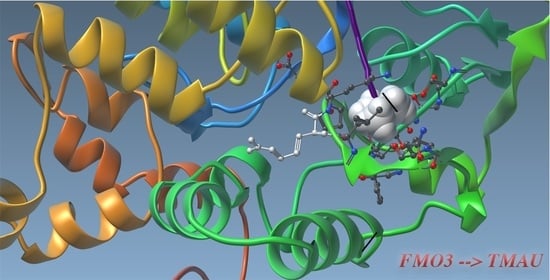
Using computational protein modelling, molecular docking and urine metabolite analysis, they proposed that combinations of variants (haplotypes) may alter how the FMO3 enzyme binds and processes trimethylamine.
Rather than viewing common variants individually, the paper suggests they should sometimes be considered together as functional genetic combinations.
The authors wrote:
"Variants classified as benign... have a high frequency in TMAU patients, frequently without the contemporary presence of causative mutations."
They therefore hypothesised that these variant combinations could reduce FMO3 activity sufficiently to contribute to disease.
Why Haplotypes Matter
A haplotype is simply a combination of genetic variants inherited together.
Each individual variant may have only a modest effect.
However, several small effects combined may reduce enzyme efficiency more than expected from considering each variant separately.
This idea is well recognised in many areas of genetics, where multiple low-impact variants together influence disease severity or susceptibility.
The Messina paper suggests that TMAU may follow a similar pattern in at least some patients.
Moving Beyond "Normal" or "Severe"
One way of thinking about this is to compare walking ability.
Traditional teaching effectively assumes there are only two categories:
walks normally
cannot walk
In reality, there is a broad spectrum.
Many people can walk but with limitations caused by arthritis, injuries, muscle weakness or neurological problems.
Likewise, FMO3 activity may exist on a spectrum rather than as a simple "working" versus "not working" enzyme.
Some people may have almost complete enzyme function.
Others may have very little.
Many may fall somewhere in between.
Those in this middle group might only develop symptoms during periods of illness, hormonal changes, dietary excess, stress, altered gut microbiota, or other metabolic challenges.
Why This Could Matter Clinically
The current diagnostic pathway often depends heavily on urine testing.
However, urinary TMA measurements can vary considerably depending on:
recent diet
timing of sample collection
symptom fluctuation
gut microbiome activity
liver enzyme activity
If a patient's urine test is normal on the day of testing, genetic analysis may never be performed.
If mild FMO3 haplotypes contribute to symptoms, this group could easily be under-recognised.
This remains a hypothesis rather than an established clinical fact, but it is one that deserves further investigation.
An Important Shift in Thinking
The significance of the Messina paper is not that it proves common variants cause TMAU.
Rather, it challenges the assumption that they are always clinically irrelevant.
Instead of asking:
"Does this patient have two rare pathogenic mutations?"
the question becomes:
"Could this particular combination of variants reduce FMO3 function enough to contribute to symptoms?"
That is a much more nuanced—and potentially more useful—way of approaching patients who do not fit the classic textbook description.
Since 2021
The Messina group's work has continued.
In 2024 they published a comprehensive review of TMAU covering genetics, molecular mechanisms, epidemiology and emerging treatments. The review again discusses the potential importance of variant combinations and the need to better understand how different FMO3 genotypes translate into clinical symptoms.
Research into treatments has also expanded.
A 2025 study investigated a mixture of postbiotics and tyndallized probiotics that reduced trimethylamine production in laboratory and animal models, highlighting growing interest in targeting the gut microbiome as part of TMAU management.
At the same time, other researchers continue to report newly identified pathogenic FMO3 mutations in different populations, demonstrating that classic severe genetic TMAU certainly exists while broadening our understanding of the condition worldwide.
If larger patient studies demonstrate that combinations of common FMO3 variants significantly reduce enzyme activity, it could eventually change how clinicians investigate patients whose symptoms are compatible with TMAU but who do not fit the traditional diagnostic model.
That would represent an important step toward recognising that TMAU may encompass a broader spectrum of FMO3 dysfunction than has historically been appreciated.
References
Alibrandi S, Nicita F, Donato L, Scimone C, Rinaldi C, D'Angelo R, Sidoti A. Adaptive Modelling of Mutated FMO3 Enzyme Could Unveil Unexplored Scenarios Linking Variant Haplotypes to TMAU Phenotypes. Molecules. 2021 Nov 22;26(22):7045. doi: 10.3390/molecules26227045. PMID: 34834137; PMCID: PMC8618768.
Alibrandi S, Nicita F, Donato L, et al. (2021). Adaptive Modelling of Mutated FMO3 Enzyme Could Unveil Unexplored Scenarios Linking Variant Haplotypes to TMAU Phenotypes.
Sidoti A, D'Angelo R, Castagnetti A, et al. (2024). Exploring Trimethylaminuria: Genetics and Molecular Mechanisms, Epidemiology, and Emerging Therapeutic Strategies.
Giannini G, Soldi S, Elli M, et al. (2025). A Mixture of Postbiotics/Tyndallized Probiotics Reduces Trimethylamine (TMA) in Trimethylaminuria Models.
Alghanem B, Alamri HS, Barhoumi T, et al. (2024). First Report from Saudi Arabia of Trimethylaminuria Caused by a Premature Stop Codon Mutation in the FMO3 Gene.
Friday, November 5, 2021
The PKU microbiome
Phenylketonuria or PKU is an inborn error of metabolism associated with a "mousy" or "musty" odor. This odor is due to a buildup of phenylalanine substances in the body. Recent study explored gut microbiome in adults with PKU and found high levels of Bifidobacterium, Bacillus, Alistipes, Clostridium, Akkermansia, and Bacteroides, while much lower levels of Lactobacillus, Porphyromonas, Frisingicoccus, Blautia, and Faecalibacterium.
REFERENCES
Mancilla VJ, Mann AE, Zhang Y, Allen MS. The Adult Phenylketonuria (PKU) Gut Microbiome. Microorganisms 2021, 9, 530.
Friday, July 2, 2021
Viruses and Vaccines
The COVID-19 Back-to-normal study was initiated in January 2021 as an effort of a tight-knit neighborhood to help each other avoid the virus and vaccinate safely.
Later the research protocol was approved by MEBO Research IRB and the study was open to other communities around the world.
By now, we have over 600 participants.
Early results of the study in MEBO/PATM community, based on the replies of the first 26 enrollees, showed that while reactions to vaccine were similar to the general population, experiences with COVID-19 infections were not - 2 individuals were not able to avoid the disease in this group, and both of them experienced long term effects.
As of today, we have stories from 41 members of MEBO/PATM community and 6 different vaccines: AstraZeneca-Oxford, Johnson & Johnson’s single-shot, Moderna, Pfizer-BioNTech, Sinovac Biotech’s CoronaVac and BBIBP-CorV, also known as the Sinopharm vaccine.
Currently, in various areas of the world, 19 COVID-19 vaccines have been authorized for use. Statistics on short-term effects of these vaccines have been published for different groups. If we compare our data to published data matching by ages and vaccines, short-term effects are very similar. Some of our sub-groups, especially healthy elderly participants, experienced far fewer side effects than reported in the literature. There were slightly fewer common adverse reactions in MEBO Pfizer group, but incidences of fatigue were on a higher side for all vaccines, and there were more reports of fever experienced after Moderna and Astrazeneca, albeit it was not significantly different from the general population. More significant differences were for less common and longer-term effects including fast heartbeat, dry mouth, skin reactions and swollen lymph nodes. The figure below shows common symptoms for Long COVID. Underlined are some of the issues reported after COVID vaccine uptakes in the group. Possible worsening of MEBO/PATM symptoms after vaccinations was reported by 10% of study participants.Why is MEBO/PATM community more susceptible to long COVID? A new study argues that long-haulers might actually be experiencing an attack of fatigue-inducing Epstein-Barr virus (EBV, a member of herpesvirus family HHV-4) that was lying dormant in their bodies. For this study, Gold and his colleagues analyzed blood of 30 people with chronic COVID (out of 185 COVID survivors). 20 out of these 30 carried high levels of EBV antibodies. Vaccines were shown to reactivate viruses too, in much rarer cases. As was demonstrated for Pfizer vaccine that woke up another herpes virus, chickenpox herpes-zoster (HHV-3), that causes shingles when reactivated (this happened to 1% of patients with autoimmune inflammatory rheumatic diseases). Herpes simplex (HSV-1) can be also kept in remission by a healthy immune system and can be also reactivated by COVID-19.
MEBO and PATM symptoms could arise following an infection. Perhaps SARS-CoV-2 can reactivate the old viruses that caused these symptoms to begin with?
Community immunity (also known as herd immunity) protects everyone. We hope that MEBO/PATM community stays COVID-free and safe.