A recent study in BMC Biology explored something many people quietly struggle with: why clothes can smell bad even after washing.
We know, it isn’t just sweat - it’s microbes.
- Washing doesn’t fully remove bacteria—it can actually increase certain types of bacteria on clothes.
- Your clothes pick up microbes not only from your body, but also from the washing machine and water.
- Humid drying (slow drying in damp air) is a major problem—it allows bacteria to grow again and recreate bad smells.
- Synthetic fabrics (like polyester) trap more odor-causing compounds than natural fabrics.
In simple terms:
👉 You wash away odor… but bacteria come back - and if clothes stay damp, they multiply and produce smell again.
What helps
1. Dry clothes FAST
- Don’t leave clothes sitting wet in the machine
- Avoid indoor damp drying if possible
-
Use:
- sunlight ☀️ (UV kills bacteria)
- a dryer
- or strong airflow
👉 The study shows humid drying = more bacteria + worse smell
2. Use the right washing settings
- Wash at higher temperatures (≥60°C when possible)
- Use oxygen bleach or antibacterial detergents occasionally
👉 Low-temp eco washes often leave bacteria behind
3. Choose better fabrics
-
Prefer:
- cotton
- wool
-
Be careful with:
- polyester / gym wear (holds smell more)
4. Clean your washing machine
- Run hot empty cycles regularly
- Clean rubber seals
- Leave the door open after use
👉 Machines themselves are a source of odor bacteria
5. Use targeted products (if needed)
- Enzyme detergents (break down sweat compounds)
- Oxygen bleach (kills microbes)
- Laundry sanitizers
👉 Not always necessary—but helpful for persistent “permastink”
6. Don’t overload or delay laundry
- Overloading reduces cleaning effectiveness
- Letting clothes sit damp = bacteria growth
Going Deeper: What Actually Causes the Smell?
🦠 “Smelliest” bacteria aren’t just one group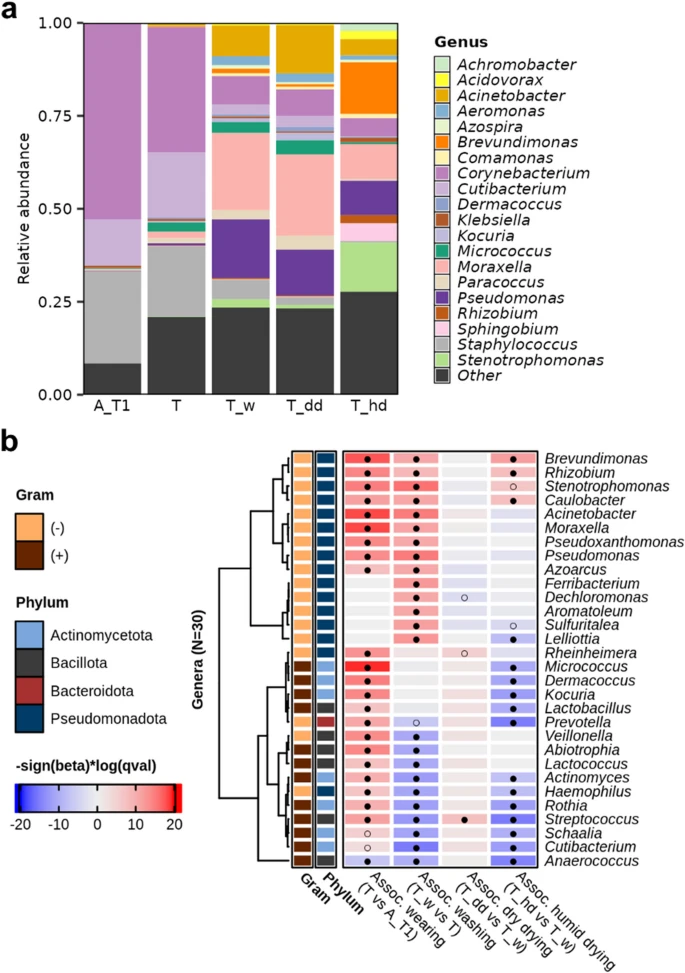
The study shows that odor isn’t caused by a single species—it’s a community effect:
-
Skin-associated Gram-positive bacteria
- e.g. Corynebacterium, Staphylococcus, Micrococcus (as also found in Gabashvili, 2020)
- Key role: break down sweat into short-chain fatty acids (classic BO smell)
-
Environment-associated Gram-negative bacteria (after washing)
- e.g. Pseudomonas, Acinetobacter, Moraxella
- Key role: thrive in moist conditions and contribute to “musty” or “wet laundry” odours
👉 Washing often replaces skin bacteria with environmental ones, rather than removing microbes entirely
🧪 The real culprits: volatile molecules (not just bacteria)
What we smell are volatile organic compounds (VOCs), especially:
- 2- & 3-methylbutanoic acid → cheesy / sweaty
- n-pentanoic, hexanoic acids → rancid / sour
- aldehydes (like octanal) → fatty / “post-wash” smell
These molecules:
- disappear after washing
- reappear during humid drying due to bacterial metabolism
🧠 Why single-method science falls short
❌ Sequencing alone is not enough

Metagenomics tells you:
- who is there
But not:
- what they are actively doing
- which ones are producing odours
👉 The paper shows huge taxonomic shifts (who’s present changes a lot)
❌ Metabolites alone are not enough
Chemical analysis (VOCs) tells you:
- what smells are present
But not:
- which microbes produced them
- how environmental conditions shaped them
🔗 The key insight: function ≠ identity
One of the most interesting findings:
- Microbial composition changes a lot
- Functional pathways stay relatively stable
👉 Different bacteria can produce the same smelly compounds
This is called functional redundancy.
🧬 Why multi-omics is essential
To truly understand laundry malodour, you need:
1. Metagenomics
- Identify microbial community
- Track shifts (skin → machine microbes)
2. Metabolomics / GC-MS
- Identify actual odour-causing compounds
3. Quantitative methods (e.g. flow cytometry)
- Measure bacterial load changes
4. Environmental context
- Temperature
- Humidity
- Fabric type
💡 Research implications
- Designing detergents should target functions (metabolism, biofilms), not just species
- Drying conditions may be as important as washing chemistry
-
Future work:
- transcriptomics (gene activity)
- real-time VOC tracking
- biofilm disruption strategies

