Thursday, November 17, 2022

Olfactory Signatures and COVID-19

Olfactory disorders have a significant impact on human lives - be it a lost/distorted sense of smell or unpleasant odors affecting the sense of smell of others. 

Odortypes can be influenced by human leukocyte antigen (HLAgenes of the major histocompatibility complex (MHC), genes associated with stronger response to COVID-19 vaccine as well as the severity of this disease. HLA may also be related to people's perception of the odor of other people. 
Of course, these are not the only variables involved, and there are more potentially overlapping risk factors for olfaction, metabolic body odor (MEBO), including trimethylaminuria (TMAU), and COVID-19: FMO3, SELENBP1HspA, UGT2A1/UGT2A2, etc. 

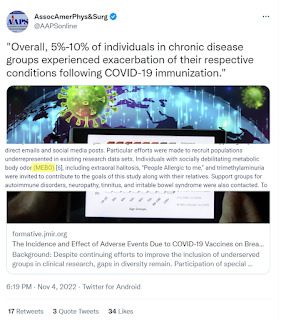
A new peer-reviewed paper reporting results of a decentralized observational study (NCT04832932) compared MEBO participants to general populations in respect to their response to COVID-19 vaccines and SARS-Co-V2 infections. 
Body odor flareups were observed in about 10% of malodor sufferers after vaccination, as preliminarily reported. This number was similar to flareups of other chronic symptoms in groups of participants with gastrointestinal and autoimmune disorders.  

Long-term worsening of body odor was observed by other researchers after COVID-19 vaccination in about ~1% of studied populations. Dry mouth leading to halitosis was 10 times more prevalent compared to flu vaccines. MEBO participants reported stronger reactions than general population pointing to genetic and microbiome influences beyond FMO3.  

A better understanding of systemic malodor conditions could offer leads for targeted therapies. Findings on genetic and microbiome overlaps between COVID-19 and MEBO could pave the way for precision medicine to address the unmet needs of odor sufferers.


REFERENCE

Gabashvili IS. The Incidence and Effect of Adverse Events Due to COVID-19 Vaccines on Breakthrough Infections: Decentralized Observational Study With Underrepresented Groups. JMIR Formative Research. 2022 Nov;6(11):e41914. DOI: 10.2196/41914. PMID: 36309347; PMCID: PMC9640199.

Monday, August 8, 2022

Workplace Stigma and Trimethylaminuria: Real Stories from South Africa

Four South Africans give their story to IOL South Africa News. 

A South African news report highlights the experiences of four people living with trimethylaminuria (TMAU), a rare metabolic disorder that causes a persistent body odor due to the body's inability to break down trimethylamine. Although the condition is not physically harmful, it has profound social and psychological consequences. Those interviewed describe workplace discrimination, bullying, isolation, anxiety, depression, and difficulty finding or keeping employment because of negative reactions to their odor. They emphasize that TMAU is a medical condition—not poor hygiene—and call for greater public understanding and empathy. The article explains that TMAU can be diagnosed with a urine test and that symptoms may be reduced by avoiding foods rich in choline and other trimethylamine precursors, although there is currently no cure.


Also on her youtube channel, Lihle talks about TMAU

https://iol.co.za/business/jobs/2022-08-08-watch-my-awful-odour-is-keeping-me-from-being-able-to-work/

https://youtu.be/mbyz9GHQi6I

Friday, June 24, 2022

MEBO Brazil YouTube channel

 ✅APRESENTAÇÃO MEMBROS SEAPOSI MEBO BRASIL | trimetilaminuria TMAU (w/ english/spanish sub).

PRESENTATION MEMBERS SEAPOSI MEBO BRAZIL TRIMETHYLAMINURIA. #tmau

The following video introduces the SEAPOSI | MEBO Brazil YouTube channel, a collaborative initiative dedicated to providing educational resources and support for people living with trimethylaminuria (TMAU) and other metabolic body odor disorders.


SEAPOSI | MEBO BRASIL youtube channel

Translation of the description on this youtube video from  this channel ...

Call notice for the Constitution Assembly of the "Association of patients with trimethylaminuria and diseases with metabolic body odor (MEBO-Brasil)". 

Welcome to SEAPOSI | MEBO BRAZIL 


We are a partnership between the Association of Patients with Trimethylaminuria and Metabolic Body Odor diseases (MEBO-Brasil) and the Support Service for Patients with Idiopathic Systemic Odor, for the dissemination of informative material to patients, families and health professionals. Your support is what motivates us to develop and promote this noble project. We count on you on this journey, subscribe to the channel and share the videos. Be an agent of transformation, thank you very much for strengthening our work. We are waiting for you in the videos!

✉️ Contact: brasilmebo@gmail.com

Wednesday, April 20, 2022

On Cabbage and Selenium Binding Protein 1

Mutations in the gene encoding Selenium Binding Protein (SELENBP1) on chromosome 1q21 were found in multiple individuals with extra-oral halitosis. These individuals had increased levels of methanethiol and dimethylsulfide in their breath perceived as unpleasantly cabbage-smelling. It was reported to worsen after drinking beer. 

The mutations responsible include rs1553204817 (OMIM: 604188.0001c.1039G>T); rs758495626 (c.673G>T (p.Gly225Trp)), rs1357490520 (c.481+1G>A disrupting splice site), and rs1553204840 (c.985C>T)

SELENBP1 was identified as a methanethiol oxidase (MTO), catalyzing the conversion of methanethiol (H3C-SH) to hydrogen sulfide (H2S), hydrogen peroxide (H2O2) and formaldehyde (HCHO). If this enzyme is not properly functional, the body will be releasing more Methanethiol  - a volatile and toxic gas with the characteristic smell of rotten cabbage. We get this compound from food - not only the cancer-fighting cabbage family, including radishes, but also orange juice, pineapple, strawberries, asparagus, wheat bread, gruyere cheese, coffee, roasted filberts and even cooked rice. Water, cherries, apples, whole milk, spinach and citrusy fruits could counteract the odor in some individuals. 

Selenium binding protein1 (SELENBP1) has been also associated with a rare disease hypermethioninemia (sometimes accompanied by learning disabilities and neurological problems), several cancers and schizophrenia (downregulated at its onset and upregulated at later stages); hypertension and ischemic heart conditions. Dysregulation of SELENBP1 is common to Zika virus (ZIKV) and dengue infections, and Guillain-Barré syndrome. It was also found to COVID-19.


REFERENCES

Pol A, Renkema GH, Tangerman A, Winkel EG, Engelke UF, De Brouwer AP, Lloyd KC, Araiza RS, Van Den Heuvel L, Omran H, Olbrich H. Mutations in SELENBP1, encoding a novel human methanethiol oxidase, cause extraoral halitosis. Nature genetics. 2018 Jan;50(1):120-9.

Philipp TM, Will A, Richter H, Winterhalter PR, Pohnert G, Steinbrenner H, Klotz LO. A coupled enzyme assay for detection of selenium-binding protein 1 (SELENBP1) methanethiol oxidase (MTO) activity in mature enterocytes. Redox Biology. 2021 Jul 1;43:101972.

Lin X, Lin Z, Zhao X, Liu Z, Xu C, Yu B, Gao P, Wang Z, Ge J, Shen Y, Li L. Serum SELENBP1 and VCL Are Effective Biomarkers for Clinical and Forensic Diagnosis of Coronary Artery Spasm. International Journal of Molecular Sciences. 2022 Oct 31;23(21):13266.

Chau EJ, Mostaid MS, Cropley V, McGorry P, Pantelis C, Bousman CA, Everall IP. Downregulation of plasma SELENBP1 protein in patients with recent-onset schizophrenia. Progress in Neuro-Psychopharmacology and Biological Psychiatry. 2018 Jul 13;85:1-6.

Zhang X, Hong R, Bei L, Hu Z, Yang X, Song T, Chen L, Meng H, Niu G, Ke C. SELENBP1 inhibits progression of colorectal cancer by suppressing epithelial–mesenchymal transition. Open Medicine. 2022 Jan 1;17(1):1390-404.

Moni MA, Lio’ P. Genetic profiling and comorbidities of zika infection. The Journal of infectious diseases. 2017 Sep 15;216(6):703-12.

de Melo CV, Bhuiyan MA, Gatua WN, Kanyerezi S, Uzairue L, Abechi P, Kumar K, Rahmat J, Giwa A, Mwandira G, Olamilekan AM. Transcriptomic dysregulations associated with SARS-CoV-2 infection in human nasopharyngeal and peripheral blood mononuclear cells. bioRxiv. 2020 Jan 1.

Albert-Puleo M. Physiological effects of cabbage with reference to its potential as a dietary cancer-inhibitor and its use in ancient medicine. Journal of ethnopharmacology. 1983 Dec 1;9(2-3):261-72.


Monday, February 28, 2022

Alianza Argentina de Pacientes work on TMAU

This video features a meeting organized by Tatiana Guendulain and Florencia Braga Menéndez (from ALAPA) focused on building a global support network for patients with TMAU and other rare diseases. The discussion emphasizes the importance of community, advocacy, and organization for those who often feel isolated. Tatiana's Channel is at https://www.youtube.com/@tatianaguendulain9565


Key Themes and Strategies:

  • Empowerment through Organization: Florencia explains that the most effective strategy for rare disease advocacy, especially in countries with limited resources, is creating umbrella organizations that unite various rare disease groups to gain visibility and influence (2:49 - 3:03, 18:24 - 18:56).
  • Global Networking: The meeting connects participants from countries including Argentina, Kenya, Puerto Rico, and the United States. Participants are encouraged to form networks, use social media for awareness, and utilize tools like WhatsApp and Clubhouse to maintain communication (4:56 - 5:24, 14:27 - 14:53, 52:03 - 52:47).
  • Accessing Research: The discussion covers the significance of tracking clinical trials (using resources like clinicaltrials.gov) to monitor and encourage local medical research development, which increases the likelihood of future treatment access (25:21 - 31:45).
  • Mental Health Support: A significant portion of the conversation focuses on the emotional toll of TMAU, including depression and social stigma. Participants like Oscar and Avienne share their personal journeys and emphasize the critical need for psychological support and the bravery required to speak out and raise awareness (32:12 - 33:34, 38:00 - 42:20).

Proposed Future Actions:

  1. Virtual Conferences: Oscar suggests organizing both virtual and, eventually, in-person conferences to bring together patients, researchers, and stakeholders to increase global awareness (23:49 - 24:38).
  2. Disability Recognition: Florencia provides a link to Orphanet resources to help patients advocate for the recognition of their condition as a disability to access institutional support (10:29 - 12:33).
  3. Ongoing Communication: The group plans to continue these meetings, potentially monthly, to refine their organizational strategy and support systems (15:43 - 16:04, 103:38 - 104:14).


Trimethylaminuria - Florencia Braga Menéndez (ALAPA)

Tatiana's TMAU webinar 26 Feb 22

Thank you Tatiana Guendulain for the TMAU webinar on 26 Feb 22.
Prof in Genetics and Biotechnology, and Phd student in chemical sciences.
And also thanks to Florencia Braga Menéndez of ALAPA for the part 2 webinar.
Here is the recording on youtube part 1 & 2 on Tatiana's youtube channel.
Feel free to subscribe to her channel.

Wednesday, February 16, 2022

Oscar talks to Healthy Nation Kenya about his TMAU

 Oscar lives in Kenya and survived the bombing of the USA Embassy in Nairobi in 1998 (he worked in a building close to the embassy).


Here he talks to a journalist from Healthy Nation Africa (Kenya edition) about his TMAU.

Thank you Oscar for raising awareness of TMAU.

For more than 20 years, Oscar, 43, has been living
in isolation because of his body odour. He moved to a different region in the country and for seven years, he has not visited Meru, his home county. It is the sniffy attitude that people have when they smell the air around him that makes him live in solitude.

Evidently so, when Healthy Nation confirmed that it would wish to have an in-person interview with him, he was restless.

"I need to prepare. What time are you likely to be here. Please let me know in advance,” Oscar said...

Link to podcast (Afripods) :

Link to Healthy Nation article & audio :


REFERENCES

Tuesday, February 15, 2022

Introducing Tatiana Guendulain

Tatiana is inviting everyone to her upcoming webinar. She would like you to fill this survey to join:


Tatiana is doing TMAU research in Argentina....  
 Some things to keep in mind:

- In order to access, you will need to have a Google account (gmail).
- If you don't want your real name to appear on the Meet screen, you can change it from "personal information" in your google account.
- The meeting will be recorded and later uploaded to my YouTube channel.

If you have any questions, do not hesitate to contact Tatiana by this means.