Friday, June 24, 2022

MEBO Brazil YouTube channel

 ✅APRESENTAÇÃO MEMBROS SEAPOSI MEBO BRASIL | trimetilaminuria TMAU (w/ english/spanish sub).

PRESENTATION MEMBERS SEAPOSI MEBO BRAZIL TRIMETHYLAMINURIA. #tmau

The following video introduces the SEAPOSI | MEBO Brazil YouTube channel, a collaborative initiative dedicated to providing educational resources and support for people living with trimethylaminuria (TMAU) and other metabolic body odor disorders.


SEAPOSI | MEBO BRASIL youtube channel

Translation of the description on this youtube video from  this channel ...

Call notice for the Constitution Assembly of the "Association of patients with trimethylaminuria and diseases with metabolic body odor (MEBO-Brasil)". 

Welcome to SEAPOSI | MEBO BRAZIL 


We are a partnership between the Association of Patients with Trimethylaminuria and Metabolic Body Odor diseases (MEBO-Brasil) and the Support Service for Patients with Idiopathic Systemic Odor, for the dissemination of informative material to patients, families and health professionals. Your support is what motivates us to develop and promote this noble project. We count on you on this journey, subscribe to the channel and share the videos. Be an agent of transformation, thank you very much for strengthening our work. We are waiting for you in the videos!

✉️ Contact: brasilmebo@gmail.com

Wednesday, April 20, 2022

On Cabbage and Selenium Binding Protein 1

Mutations in the gene encoding Selenium Binding Protein (SELENBP1) on chromosome 1q21 were found in multiple individuals with extra-oral halitosis. These individuals had increased levels of methanethiol and dimethylsulfide in their breath perceived as unpleasantly cabbage-smelling. It was reported to worsen after drinking beer. 

The mutations responsible include rs1553204817 (OMIM: 604188.0001c.1039G>T); rs758495626 (c.673G>T (p.Gly225Trp)), rs1357490520 (c.481+1G>A disrupting splice site), and rs1553204840 (c.985C>T)

SELENBP1 was identified as a methanethiol oxidase (MTO), catalyzing the conversion of methanethiol (H3C-SH) to hydrogen sulfide (H2S), hydrogen peroxide (H2O2) and formaldehyde (HCHO). If this enzyme is not properly functional, the body will be releasing more Methanethiol  - a volatile and toxic gas with the characteristic smell of rotten cabbage. We get this compound from food - not only the cancer-fighting cabbage family, including radishes, but also orange juice, pineapple, strawberries, asparagus, wheat bread, gruyere cheese, coffee, roasted filberts and even cooked rice. Water, cherries, apples, whole milk, spinach and citrusy fruits could counteract the odor in some individuals. 

Selenium binding protein1 (SELENBP1) has been also associated with a rare disease hypermethioninemia (sometimes accompanied by learning disabilities and neurological problems), several cancers and schizophrenia (downregulated at its onset and upregulated at later stages); hypertension and ischemic heart conditions. Dysregulation of SELENBP1 is common to Zika virus (ZIKV) and dengue infections, and Guillain-Barré syndrome. It was also found to COVID-19.


REFERENCES

Pol A, Renkema GH, Tangerman A, Winkel EG, Engelke UF, De Brouwer AP, Lloyd KC, Araiza RS, Van Den Heuvel L, Omran H, Olbrich H. Mutations in SELENBP1, encoding a novel human methanethiol oxidase, cause extraoral halitosis. Nature genetics. 2018 Jan;50(1):120-9.

Philipp TM, Will A, Richter H, Winterhalter PR, Pohnert G, Steinbrenner H, Klotz LO. A coupled enzyme assay for detection of selenium-binding protein 1 (SELENBP1) methanethiol oxidase (MTO) activity in mature enterocytes. Redox Biology. 2021 Jul 1;43:101972.

Lin X, Lin Z, Zhao X, Liu Z, Xu C, Yu B, Gao P, Wang Z, Ge J, Shen Y, Li L. Serum SELENBP1 and VCL Are Effective Biomarkers for Clinical and Forensic Diagnosis of Coronary Artery Spasm. International Journal of Molecular Sciences. 2022 Oct 31;23(21):13266.

Chau EJ, Mostaid MS, Cropley V, McGorry P, Pantelis C, Bousman CA, Everall IP. Downregulation of plasma SELENBP1 protein in patients with recent-onset schizophrenia. Progress in Neuro-Psychopharmacology and Biological Psychiatry. 2018 Jul 13;85:1-6.

Zhang X, Hong R, Bei L, Hu Z, Yang X, Song T, Chen L, Meng H, Niu G, Ke C. SELENBP1 inhibits progression of colorectal cancer by suppressing epithelial–mesenchymal transition. Open Medicine. 2022 Jan 1;17(1):1390-404.

Moni MA, Lio’ P. Genetic profiling and comorbidities of zika infection. The Journal of infectious diseases. 2017 Sep 15;216(6):703-12.

de Melo CV, Bhuiyan MA, Gatua WN, Kanyerezi S, Uzairue L, Abechi P, Kumar K, Rahmat J, Giwa A, Mwandira G, Olamilekan AM. Transcriptomic dysregulations associated with SARS-CoV-2 infection in human nasopharyngeal and peripheral blood mononuclear cells. bioRxiv. 2020 Jan 1.

Albert-Puleo M. Physiological effects of cabbage with reference to its potential as a dietary cancer-inhibitor and its use in ancient medicine. Journal of ethnopharmacology. 1983 Dec 1;9(2-3):261-72.


Monday, February 28, 2022

Alianza Argentina de Pacientes work on TMAU

This video features a meeting organized by Tatiana Guendulain and Florencia Braga Menéndez (from ALAPA) focused on building a global support network for patients with TMAU and other rare diseases. The discussion emphasizes the importance of community, advocacy, and organization for those who often feel isolated. Tatiana's Channel is at https://www.youtube.com/@tatianaguendulain9565


Key Themes and Strategies:

  • Empowerment through Organization: Florencia explains that the most effective strategy for rare disease advocacy, especially in countries with limited resources, is creating umbrella organizations that unite various rare disease groups to gain visibility and influence (2:49 - 3:03, 18:24 - 18:56).
  • Global Networking: The meeting connects participants from countries including Argentina, Kenya, Puerto Rico, and the United States. Participants are encouraged to form networks, use social media for awareness, and utilize tools like WhatsApp and Clubhouse to maintain communication (4:56 - 5:24, 14:27 - 14:53, 52:03 - 52:47).
  • Accessing Research: The discussion covers the significance of tracking clinical trials (using resources like clinicaltrials.gov) to monitor and encourage local medical research development, which increases the likelihood of future treatment access (25:21 - 31:45).
  • Mental Health Support: A significant portion of the conversation focuses on the emotional toll of TMAU, including depression and social stigma. Participants like Oscar and Avienne share their personal journeys and emphasize the critical need for psychological support and the bravery required to speak out and raise awareness (32:12 - 33:34, 38:00 - 42:20).

Proposed Future Actions:

  1. Virtual Conferences: Oscar suggests organizing both virtual and, eventually, in-person conferences to bring together patients, researchers, and stakeholders to increase global awareness (23:49 - 24:38).
  2. Disability Recognition: Florencia provides a link to Orphanet resources to help patients advocate for the recognition of their condition as a disability to access institutional support (10:29 - 12:33).
  3. Ongoing Communication: The group plans to continue these meetings, potentially monthly, to refine their organizational strategy and support systems (15:43 - 16:04, 103:38 - 104:14).


Trimethylaminuria - Florencia Braga Menéndez (ALAPA)

Tatiana's TMAU webinar 26 Feb 22

Thank you Tatiana Guendulain for the TMAU webinar on 26 Feb 22.
Prof in Genetics and Biotechnology, and Phd student in chemical sciences.
And also thanks to Florencia Braga Menéndez of ALAPA for the part 2 webinar.
Here is the recording on youtube part 1 & 2 on Tatiana's youtube channel.
Feel free to subscribe to her channel.

Wednesday, February 16, 2022

Oscar talks to Healthy Nation Kenya about his TMAU

 Oscar lives in Kenya and survived the bombing of the USA Embassy in Nairobi in 1998 (he worked in a building close to the embassy).


Here he talks to a journalist from Healthy Nation Africa (Kenya edition) about his TMAU.

Thank you Oscar for raising awareness of TMAU.

For more than 20 years, Oscar, 43, has been living
in isolation because of his body odour. He moved to a different region in the country and for seven years, he has not visited Meru, his home county. It is the sniffy attitude that people have when they smell the air around him that makes him live in solitude.

Evidently so, when Healthy Nation confirmed that it would wish to have an in-person interview with him, he was restless.

"I need to prepare. What time are you likely to be here. Please let me know in advance,” Oscar said...

Link to podcast (Afripods) :

Link to Healthy Nation article & audio :


REFERENCES

Tuesday, February 15, 2022

Introducing Tatiana Guendulain

Tatiana is inviting everyone to her upcoming webinar. She would like you to fill this survey to join:


Tatiana is doing TMAU research in Argentina....  
 Some things to keep in mind:

- In order to access, you will need to have a Google account (gmail).
- If you don't want your real name to appear on the Meet screen, you can change it from "personal information" in your google account.
- The meeting will be recorded and later uploaded to my YouTube channel.

If you have any questions, do not hesitate to contact Tatiana by this means.

Wednesday, January 12, 2022

Post-infectious body odor

Every infection has a distinct odor. It could be associated with changes in the gut microbiome. Besides, circulating B-cells from our immune system are also producing chemical odors that appear after viral infection. T-cell and cytokine involvement is also possible. Infections can change body odor for the worse.  PATM or MEBO conditions could begin after an infection and linger thereafter.  


COVID-19 is known to be associated with a specific odor.  Early studies identified volatile compounds that discriminated COVID-19 from other conditions. Some of these compounds - such as fruity smelling ketones - are also associated with diabetes - a risk factor for Severe COVID-19 infection. Another compound, Heptanal, associated with lung cancer, can also predict the severity of the Coronavirus disease.

Dogs (and rats and other animals) can easily detect the smell of COVID-19. They are already helping during this pandemic - Massachusetts schools, for example, are using dogs to sniff out Covid-19. The dogs come to the schools weekly and work to detect cases in empty classrooms, auditoriums, cafeterias and gymnasiums, If Covid is detected, the authorities tell the health nurse who relays the information to the people affected.

Long COVID - when people continue to have symptoms of COVID-19 for months after their initial illness. - has a distinct smell as well. A paper posted today on MedRxiv tells that dogs can easily detect long COVID as well - in at least half of the cases. 

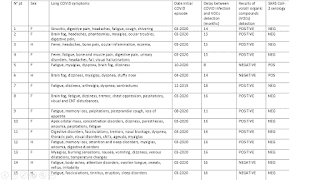
Between May and October 2021, 45 Long COVID patients sent their axillary sweat samples to the National Veterinary School of Alfort. Average age of the patients was 45 (6-71) and 73.3% were female. No patient had been admitted in intensive care unit during the acute phase. Prolonged symptoms had been evolving for an average of 15.2 months (range: 5-22). Main symptoms of prolonged phase were intense fatigue (n=37, 82.2%), neurocognitive disorders such as concentration and attention difficulties, immediate memory loss (n=24, 53.3%), myalgias/arthralgias (n=22, 48.9%), cardiopulmonary symptoms (dyspnea, cough, chest pain, palpitations) (n=21, 46.7%), digestive symptoms (diarrhea, abdominal pain, reflux, gastroparesis...) (n=18, 40.0%), ENT disorders (hyposmia, parosmia, tinnitus, nasal obstruction, inflammatory tongue, dysphonia, sinusitis) (n=18, 40.0%) (table 1). 11 (24.4) patients had at least one positive SARS-CoV-2 serology before any vaccination, 29 (64.4%) had a negative SARS-CoV-2 serology and 5 (11.1%) had no serology results. Snapshot of the table shows some of the cases. Interestingly, patients with odor exhibited symptoms similar to long COVID sufferers in the MEBO community. This includes loss of smell and heart palpitations. 


REFERENCES


Dominique GRANDJEAN, Dorsaf SLAMA, Capucine GALLET, Clothilde JULIEN, Emilie SEYRAT, Marc BLONDOT, Maissa BENAZAZIEZ, Judith ELBAZ, Dominique SALMON Screening for SARS-CoV-2 persistence in Long COVID patients using sniffer dogs and scents from axillary sweats samples  medRxiv 2022.01.11.21268036; doi: https://doi.org/10.1101/2022.01.11.21268036

Tuesday, January 4, 2022

Worried about body odor?

You are not alone. According to pre-COVID surveys, over one third said the fear of smelling unpleasant left them feeling unhappy and unattractive. Many people who survived COVID-19 worry about their body odor getting worse post-infection.

A team of researchers from Virginia Commonwealth University surveyed 322 individuals with loss of smell or taste as a result of confirmed COVID-19 infection and found that about half of them felt depressed and worried about their body odor [Coelho et al., 2021].  Extrapolating results of other surveys, this translates into about 20% of those who got through COVID-19.  

The most frequently reported phantom smell (likely not actually there) is the odor of smoke or burned food [Frasnelli et al, 2004]. Interestingly, these are also the most frequently reported types of smells that long-COVID sufferers can't perceive, when others detect them. 

Temporary loss of smell is common. About 20% of population experience it sometime before the age of 75. This number increases to ~80% in older age. 

Loss of smell associated with viral infections, especially COVID-19 is much more prevalent. Sometimes it's the only symptom associated with this infection. A meta-analysis of published reports reveals that the overall prevalence of alteration of the sense of smell or taste following COVID-19 infection ranges between 31% and 67% in severe and mild-to-moderate symptomatic patients, respectively. Fortunately, in most (70-80%) cases it comes back in 6 month or longer. A higher recovery rate was highlighted for subjects who underwent influenza vaccination. 

REFERENCES

Coelho DH, Reiter ER, Budd SG, Shin Y, Kons ZA, Costanzo RM. Quality of life and safety impact of COVID-19 associated smell and taste disturbances. American Journal of Otolaryngology. 2021 Jul 1;42(4):103001.

Frasnelli J, Landis BN, Heilmann S, Hauswald B, Hüttenbrink KB, Lacroix JS, Leopold DA, Hummel T. Clinical presentation of qualitative olfactory dysfunction. European Archives of Oto-Rhino-Laryngology and Head & Neck. 2004 Aug;261(7):411-5. 

Maiorano E, Calastri A, Robotti C, Cassaniti I, Baldanti F, Zuccaro V, Stellin E, Ferretti VV, Klersy C, Benazzo M. Clinical, virological and immunological evolution of the olfactory and gustatory dysfunction in COVID-19. American Journal of Otolaryngology. 2022 Jan 1;43(1):103170.

Vaira LA, De Vito A, Lechien JR, Chiesa‐Estomba CM, Mayo‐Yàñez M, Calvo‐Henrìquez C, Saussez S, Madeddu G, Babudieri S, Boscolo‐Rizzo P, Hopkins C. New onset of smell and taste loss are common findings also in patients with symptomatic COVID‐19 after complete vaccination. The Laryngoscope. 2021 Nov 26.